A Complete Guide to Slogans to Stop Bullying
Bullying prevention efforts rely on more than policy documents and disciplinary procedures they rely on language that reaches students, parents, and educators where they actually spend their attention.
Slogans to stop bullying condense a serious message into something short enough to fit on a poster, a t-shirt, or a classroom banner, giving schools and organizations a practical tool for keeping the issue visible year-round rather than only during a single assembly.
In this guide, we’ll cover why these slogans matter for prevention efforts, look at real examples used across schools and national campaigns, explain the communication principles that make them effective, and walk through a practical process for writing your own.
This is a working guide grounded in documented prevention research and real organizations, built to genuinely help educators, students, and parents create messaging that actually resonates rather than blending into the background noise of school hallway posters.
Why Slogans to Stop Bullying Matter in Prevention Work
A bullying prevention policy explains the rules. A well-written slogan reminds people of the underlying value behind those rules on a daily basis, in the hallway, on social media, and in casual conversation.
That distinction matters because research from organizations like StopBullying.gov consistently shows that prevention is most effective when it becomes part of an ongoing school culture rather than a single isolated lesson.
Slogans to stop bullying work because they’re portable in a way that longer educational materials aren’t. A phrase printed on a locker sign, repeated during morning announcements, or shared on social media can reinforce a message dozens of times throughout a school year.
Building the kind of repeated exposure that behavioral research shows is necessary for messaging to actually influence attitudes and behavior over time.
“Be the reason someone feels included today” reframes prevention from a rule to follow into a positive action students can take, which is part of why this kind of phrasing has become common in modern anti-bullying campaigns.
A Brief History of Anti-Bullying Messaging
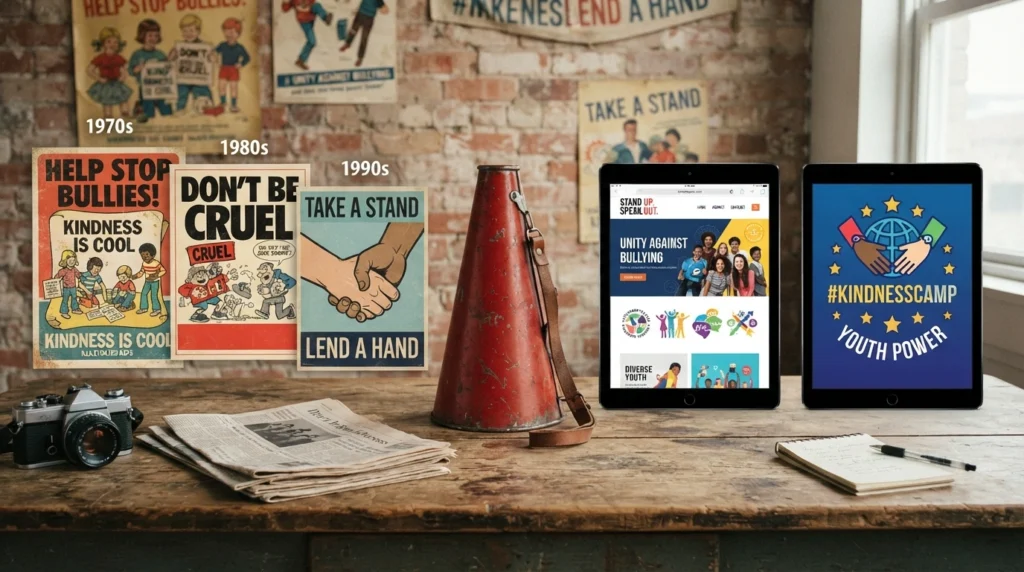
Public awareness campaigns around bullying have changed significantly over the past few decades, shifting in both tone and strategy as research on the topic has developed.
Early Awareness Efforts (1990s–2000s)
Organized anti-bullying campaigns in American schools gained significant momentum in the late 1990s and 2000s, often following high-profile incidents that drew national attention to the issue.
Early messaging from this period tended to focus heavily on discouraging specific negative behaviors, using direct, rule-based language aimed at telling students what not to do.
The Shift Toward Positive Messaging (2010s)
As prevention research matured, public health and education organizations increasingly shifted toward positive, action-oriented messaging rather than purely prohibitive language.
According to PACER’s National Bullying Prevention Center, this period introduced a wave of slogans to stop bullying that emphasized kindness, inclusion, and active bystander intervention rather than simply telling students to avoid negative behavior.
Modern Anti-Bullying and Cyberbullying Campaigns (2015–Present)
The rise of social media introduced a new dimension to bullying prevention, prompting organizations to develop messaging specifically addressing online harassment alongside traditional in-person bullying.
Modern slogans to stop bullying increasingly acknowledge that harmful behavior can follow students beyond the classroom, and many current campaigns pair short, shareable phrases with digital citizenship education to address this broader landscape.
Popular Slogans to Stop Bullying Used in Schools and Campaigns
Here are some of the most widely referenced slogans to stop bullying used across schools, national campaigns, and prevention organizations:
- “Be the Reason Someone Smiles Today” A positive, action-focused phrase common in elementary and middle school campaigns.
- “Stand Up, Speak Out” A phrase encouraging active bystander intervention rather than silent observation.
- “Kindness Is Contagious, Pass It On” A phrase framing positive behavior as something that spreads through a community.
- “No One Deserves to Feel Alone” A phrase emphasizing empathy and inclusion.
- “Words Can Build or Break, Choose Wisely” A phrase addressing the impact of verbal bullying directly.
- “See Something, Say Something, Support Someone” A phrase widely used in bystander intervention training materials.
- “Together We Rise, Together We Stand” A phrase emphasizing community and collective responsibility.
Each of these slogans to stop bullying reflects a slightly different approach, from encouraging bystander action to emphasizing empathy and inclusion as everyday values rather than one-time lessons.
Why These Slogans Are Designed the Way They Are

Prevention communication researchers point to a few consistent principles behind effective slogans to stop bullying, drawn from broader behavioral science and public health messaging research:
- Positive framing over prohibition Research consistently shows that messaging framed around positive actions, such as “include others,” tends to be more effective than simply telling students what not to do.
- Bystander empowerment Many effective slogans specifically address bystanders rather than only victims or perpetrators, since research shows peer intervention significantly reduces bullying incidents.
- Repetition and visibility Short, memorable phrases repeated consistently across posters, announcements, and events build the kind of ongoing cultural presence that single assemblies or one-time lessons cannot achieve on their own.
Understanding these principles helps explain why certain slogans to stop bullying have been widely adopted across school districts nationally, while more punitive or vague phrases tend to have less lasting impact on school culture.
How Schools and Organizations Use These Slogans in Practice
Slogans to stop bullying appear across a wide range of school and community settings. Many schools incorporate them into National Bullying Prevention Month observances each October, using posters, morning announcements, and student-led activities to reinforce the message throughout the month rather than relying on a single event.
Organizations such as StopBullying.gov, a federal government website managed in partnership with the U.S.
Department of Health and Human Services, and PACER’s National Bullying Prevention Center provide free educational resources, including recommended messaging and campaign materials that schools can adapt for local use.
These resources often pair specific slogans with lesson plans and discussion guides, helping ensure the messaging is reinforced with substantive educational content rather than standing alone as decoration.
Slogans Addressing Cyberbullying Specifically
As online harassment has become a growing concern alongside traditional in-person bullying, a distinct category of slogans to stop bullying has emerged specifically addressing digital behavior. These phrases often emphasize the permanence and reach of online actions:
- “Think Before You Post, Kindness Never Expires” Addresses the lasting impact of online comments.
- “Screens Don’t Erase Feelings” Directly connects online behavior to real emotional impact.
- “Log Off Hate, Log In Kindness” A phrase pairing digital habits with positive behavior.
- “Behind Every Screen Is a Real Person” Encourages empathy in online interactions.
- “Report It, Don’t Repost It” A practical, action-oriented phrase addressing the spread of harmful content.
These cyberbullying-focused slogans to stop bullying reflect how prevention messaging has expanded to address behavior across both physical and digital environments.
Tips for Writing Effective Anti-Bullying Slogans
If you’re creating materials for a classroom project, school campaign, or community awareness event, here are practical tips grounded in current prevention research:
- Frame the message around positive action. Phrases that tell people what to do, such as “include others” or “speak up,” tend to be more effective than purely prohibitive language.
- Address bystanders specifically. Since peer intervention has a significant impact on reducing bullying, consider messaging that empowers witnesses to act rather than focusing only on victims or perpetrators.
- Keep it short and repeatable. Aim for six to ten words so the phrase can be easily printed on posters, shared on social media, or repeated during announcements.
- Avoid shaming language. Slogans that focus on blame rather than positive change can feel punitive rather than genuinely supportive of a healthier school culture.
- Pair the slogan with real resources. A memorable phrase works best alongside actual reporting procedures, counseling resources, or educational programming, not as a replacement for them.
Studying how national prevention organizations have shifted their messaging over time, from rule-based language toward positive, bystander-focused phrasing, offers a useful lesson for anyone writing new anti-bullying materials.
Common Mistakes to Avoid
Even well-intentioned campaigns can undercut their own message with a few recurring mistakes. Watch for the following when developing slogans to stop bullying:
- Overly punitive language. Slogans that focus heavily on punishment rather than positive behavior can feel discouraging rather than empowering to students.
- Vague, generic phrasing. Broad statements like “Bullying Is Bad” state the obvious without giving students any specific action to take.
- Ignoring the digital dimension. Modern prevention messaging that only addresses in-person bullying misses a significant portion of how harassment occurs today.
- One-time use instead of ongoing reinforcement. A slogan used once during an assembly has far less impact than one repeated consistently throughout the school year.
Frequently Asked Questions
What is an effective slogan to stop bullying for elementary school students?
Simple, positive phrases like “Be the Reason Someone Smiles Today” work well for younger students because they focus on a clear, achievable action rather than abstract concepts.
Why do modern anti-bullying slogans focus on bystanders instead of just victims?
Research shows that bystander intervention significantly reduces bullying incidents, which is why many current slogans to stop bullying specifically encourage witnesses to speak up rather than stay silent.
Are there official resources for anti-bullying campaign materials?
Yes. StopBullying.gov, a federal resource managed with the U.S. Department of Health and Human Services, and PACER’s National Bullying Prevention Center both provide free, research-based prevention materials and messaging guidance.
Do slogans to stop bullying need to address cyberbullying separately?
Given how much bullying now occurs online, many modern campaigns include cyberbullying-specific messaging alongside traditional in-person prevention slogans to address the full scope of the issue.
Can students help create anti-bullying slogans for their school?
Yes. Many schools involve student councils or peer leadership groups in creating campaign materials, which research suggests can improve the effectiveness of messaging since it reflects language students actually relate to.
Conclusion
Slogans to stop bullying serve a practical role in prevention efforts, translating serious research about school culture and behavior into language simple enough to appear on a poster, a t-shirt, or a social media post.
From early rule-based messaging to today’s positive, bystander-focused campaigns addressing both in-person and online behavior, these phrases reflect an evolving understanding of what actually helps reduce bullying in schools and communities.
Whether you’re an educator building classroom materials, a student leading a school campaign, or a parent looking to support prevention efforts at home, understanding the research behind effective messaging can help ensure your words genuinely contribute to a safer, more inclusive environment.
References
- StopBullying.gov, U.S. Department of Health and Human Services stopbullying.gov
- PACER’s National Bullying Prevention Center pacer.org
- Substance Abuse and Mental Health Services Administration (SAMHSA), “Bullying Prevention Resources” samhsa.gov
- Cyberbullying Research Center cyberbullying.org
- National Education Association, “Bullying Prevention in Schools” nea.org
- Centers for Disease Control and Prevention (CDC), “Youth Risk Behavior and Bullying Data” cdc.gov